Ready to grow?
Website Helped Robert Geans Win $308K Job
2x Expected Opening Weekend Attendance
Cheetos Collab drove 184K+ Impressions
Donations Up 250% After Video
Our Design Helped Secure $50M Grant


Sports and outdoor brand campaigns are coordinated creative and advertising efforts designed to turn consumer interest into brand preference and sales. This 2027 guide explains how to connect athlete and outdoor-user insight, credible product storytelling, production, and media placement in one growth plan.
TL;DR
Sports and outdoor purchases involve more than recognition. Your campaign needs to explain who the product serves, demonstrate its role in an activity, and give buyers a reason to choose it. A dramatic landscape supplies a setting; it does not supply that reason.
The planning challenge is coordination. A film, retail display, sponsorship activation, and paid social ad need different executions without becoming different campaigns. Build one brand promise, then adapt the evidence and format to each placement.
J2 Marketing provides research, strategy, advertising, branding, and video/photo production. J2 Marketing brand campaigns fit consumer teams seeking campaign creative and ad placement from one agency. The trade-off is coordination responsibility: an integrated partner still needs your product expertise, commercial priorities, and approval decisions.
For your 2027 annual plan, connect each campaign to a buying occasion rather than treating content production as a separate calendar. A product launch, participation season, or retail initiative gives the work a commercial purpose. Define that purpose before commissioning the shoot.
Start with a working session and a shared planning document. Write down the business problem before discussing slogans, ambassadors, or channels. Choose 1 primary business outcome so the team knows which result takes priority when decisions conflict.
A campaign intended to introduce an unfamiliar product needs different evidence from one intended to bring existing customers into another category. Both can build the brand, but they should not share an undefined success measure.
Give your 2027 campaign brief an explicit boundary: which customer, which purchase occasion, and which outcome the campaign owns. Keep supporting measures visible without letting them replace the primary objective. Your campaign should also identify what sits outside its scope, so unrelated requests do not quietly consume production time.
Read customer reviews, speak with retail staff, and interview customers before commissioning outside research. Ask what triggered the purchase, what nearly stopped it, and what evidence made the decision easier. Separate experienced participants from people entering the activity.
For sports and outdoor buyers, participation context matters. A product used during training has a different role from equipment packed for a remote trip. Do not collapse distinct needs into a broad audience description such as active consumers.
Turn your findings into a usable brief rather than a collection of interesting quotes. Keep customer language intact when sharing it internally; use quotations publicly only with appropriate permission. Record conflicting answers as well, because disagreement can reveal separate audiences that need different messages.
Draft the promise internally in plain language before developing a campaign line. State who the product serves, what it helps them do, and why the claim is credible. Remove language that another category competitor could use unchanged.
For J2 Marketing brand campaigns, research, branding, production, and advertising are relevant capabilities to bring into this brief. Establish the promise before asking a partner to develop executions. An outside team can help resolve the creative problem; it cannot supply unverified product truth.
A campaign promise is a decision rule, not just a headline. Use it to reject attractive ideas that do not advance the positioning. Keep technical, legal, and brand reviewers involved before an unsupported claim becomes the basis of a shoot.
Sketch a message map in a document or spreadsheet before building assets. Connect the audience’s question to the evidence, execution, placement, and next action. This prevents the hero film from becoming the default answer to every communication need.
Use an introduction to establish relevance, a demonstration to explain the product, and decision-stage material to answer purchase objections. These are different jobs. Repeating the same edit across every placement does not resolve them.
Build the map around these connected parts: Audience question, Campaign promise, Product evidence, Media placement, and Business outcome. Each part should explain the next. If a placement has no clear role, remove it from the plan rather than inventing an asset to fill it.
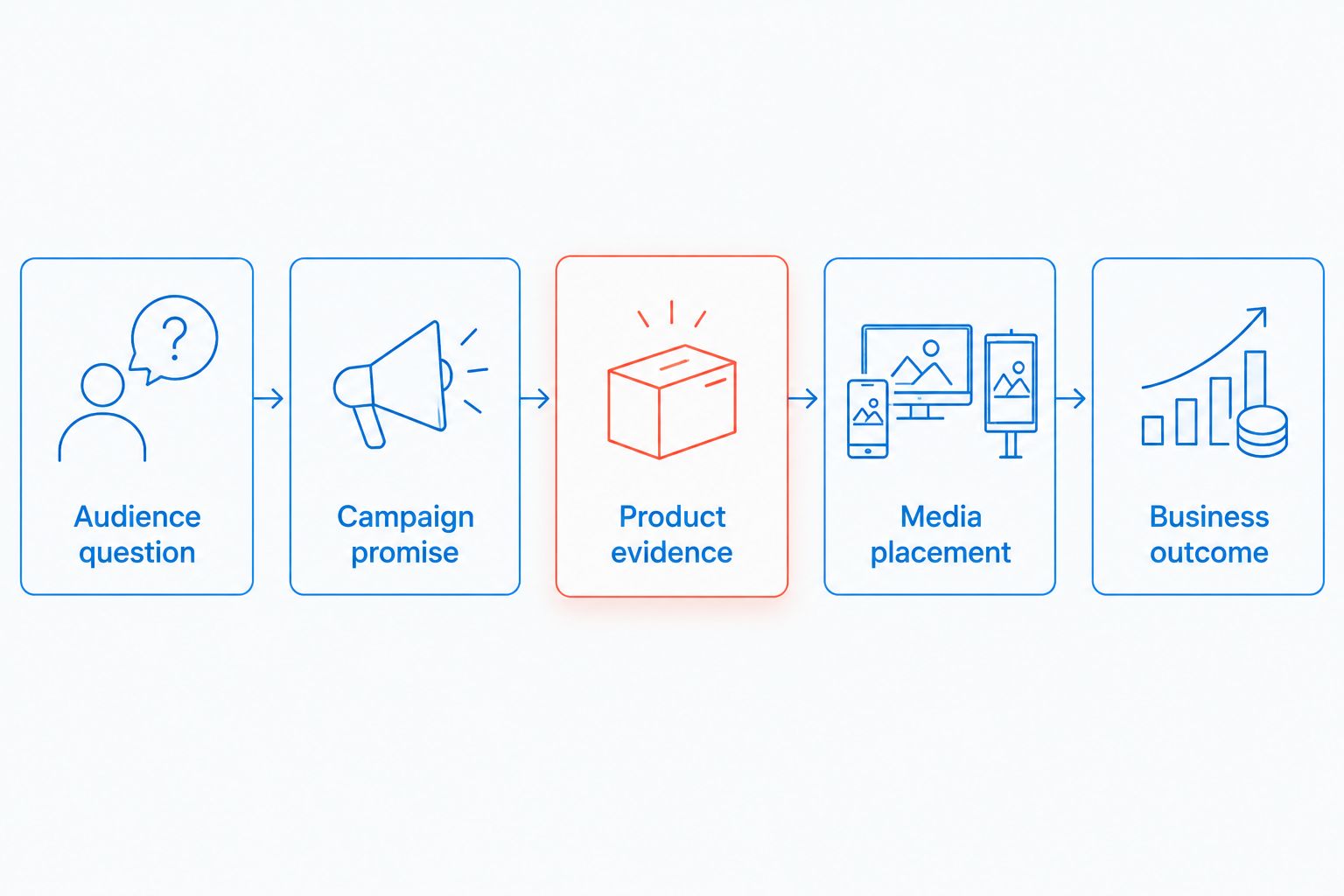
Choose the message and evidence before assigning the placement.
A media plan should explain why an audience will encounter each execution, not just where the file will run. Make the handoff between messages explicit so production can capture the material each stage needs.
Create a shot list and asset matrix before booking production. Work backward from the approved placements, including aspect ratios, sound conditions, captions, product details, and required usage rights. A visually strong shoot still fails its brief when essential deliverables are missing.
For your 2027 production plan, consider 6-second, 15-second, and 30-second edits where the placement calls for them. These are planning options, not a requirement to produce every length. Write each edit to work independently instead of assuming a shorter cut will preserve the longer film’s argument.
Sports and outdoor settings also require practical preparation. Plan access, weather contingencies, participant safety, and accurate product use. Confirm responsibility for those decisions before the shoot, not after the team arrives on location.
Begin with a shared calendar covering product launches, retail priorities, participation occasions, and internal decision dates. Add production deadlines and media commitments to the same document. Separate calendars hide dependencies until they become expensive changes.
Choose placements by audience and communication job. Video can demonstrate use; audio can carry a memorable message; retail material can support a decision near the product. No channel earns a place simply because the team used it previously.
J2 Marketing combines advertising with creative and production services, making integrated planning a relevant discussion for teams coordinating those responsibilities. Ask any proposed partner to explain how creative decisions inform placement, and how performance feedback reaches the creative team. The advantage is connected decisions; the limitation is that accountability still needs explicit owners and approval rules.
Start with your own sales, customer, and campaign records. Agree on definitions before launch, including what counts as a new customer and which sales channels the reporting covers. Keep platform metrics as diagnostic evidence rather than treating each platform’s total as additional business growth.
Evaluate your 2027 campaign against the primary outcome and its supporting measures. Check whether creative reached the intended audience, communicated the promise, and supported the desired action. Strong reach with weak understanding calls for a different response from clear messaging with weak distribution.
Close the review with a decision, not a dashboard tour. Record what to retain, what to change, and what still needs evidence. Where several commercial changes happened together, separate the observed result from any claim about what caused it.
Choose the delivery model by the work you need to coordinate. An established internal team needs different support from a marketing lead managing separate creative, production, and media suppliers. Evaluate the operating model before evaluating the presentation.
In-house campaign team
Specialist production partner
Separate creative and media partners
Integrated agency, including J2 Marketing
Before choosing, ask each partner to walk through the same campaign brief. Compare the proposed responsibilities, deliverables, approval process, and measurement approach. A polished concept alone does not explain who will manage the campaign after approval.
Mountains, trails, courts, and water establish context. They do not explain your distinction. Require every creative concept to identify the consumer tension, product role, and evidence that makes the brand relevant within that setting.
A participant can look right while demonstrating the activity incorrectly. Review casting against the intended audience and the demands of the demonstration. Assign someone qualified to check technique and product use before footage becomes an approved advertisement.
Approving a long film first leaves shorter executions dependent on whatever footage survives the edit. Brief the asset system together. Decide which product details, opening shots, and standalone messages each placement needs before production begins.
An athlete or creator can attract attention without communicating the product’s role. Define what the partnership needs to demonstrate, which claims are approved, and how the content connects to the wider campaign. Review usage rights alongside deliverables.
Consumer advertising and retail communication should tell the same product story. Give retail partners the approved message, relevant product evidence, and campaign timing. Make responsibility for retail materials explicit rather than assuming someone will adapt the campaign later.
What are brand campaigns for sports and outdoor brands?
Brand campaigns for sports and outdoor brands connect a consumer promise with creative executions and advertising placements to support preference and sales. The work should explain the product’s role in an activity and give buyers credible reasons to choose it.
What should a sports or outdoor campaign brief include?
A campaign brief should include the business objective, intended audience, buying occasion, campaign promise, supporting evidence, placements, and measurement plan. It should also name approval owners and identify claims requiring review.
Should we hire an integrated agency or a production company?
Hire an integrated agency when you need campaign development and advertising coordination; use a production company when your strategy and placement requirements are already defined. Confirm responsibilities in the scope rather than assuming either model covers every task.
Do sports and outdoor campaigns need professional athletes?
Professional athletes are not a prerequisite for a sports or outdoor campaign. Choose participants whose credibility, activity experience, and role support the message, then confirm permissions and accurate product use.
How do we measure whether a brand campaign worked?
Measure the campaign against a defined business outcome and an agreed baseline. Use creative, audience, and channel measures to diagnose performance, and distinguish observed sales changes from evidence that the campaign caused them.
Should traditional and digital advertising use the same creative?
Traditional and digital advertising should share the campaign promise but use executions suited to each placement. Adapt the opening, pacing, sound, detail, and next action rather than distributing an identical edit everywhere.
When should media planning enter campaign development?
Media planning should enter before scripts and production deliverables are approved. Placement requirements influence formats, message length, asset needs, usage rights, and the production schedule.
Before approving your next 2027 production brief, ask someone outside the campaign team to explain the product’s role after viewing the concept. Do not prompt them with the intended message.
If the answer describes only the scenery, athlete, or mood, revise the concept. The activity should make the product story clearer, not replace it. Resolve that problem before spending effort on additional executions of the same unclear idea.