Ready to grow?
Website Helped Robert Geans Win $308K Job
2x Expected Opening Weekend Attendance
Cheetos Collab drove 184K+ Impressions
Donations Up 250% After Video
Our Design Helped Secure $50M Grant



Credit union commercial video production is the creation of advertising videos with the aim of growing membership, increasing product adoption, or strengthening member relationships. Unlike general consumer advertising, credit union campaigns must connect a clear member benefit with eligibility, accurate financial claims, and a measurable business objective.
TL;DR
A credit union commercial needs to give the right person a reason to act. A polished film without a defined audience, distribution plan, or next step leaves your marketing team with an asset rather than a campaign.
Membership advertising has a particular constraint: interest does not automatically mean eligibility. Product advertising has another: a compelling offer still needs accurate terms and appropriate disclosures. Your creative must make the benefit understandable without letting production choices bury material information.
For your 2027 annual plan, connect Campaign, Creative/Studio, and Ad Placement before assigning production resources. J2 Marketing provides strategy, advertising, and video/photo production; the relevant question is how those services support the same membership or product-growth objective.
Judge a commercial by the business action it supports, not by how impressive the shoot looks. A member story, product explanation, and brand campaign serve different purposes. Choose the purpose first.
Keep the planning sequence simple: Business objective, Audience, Creative concept, Media placement, Measurement. Each decision supplies a requirement for the next; none should wait until the finished video arrives.
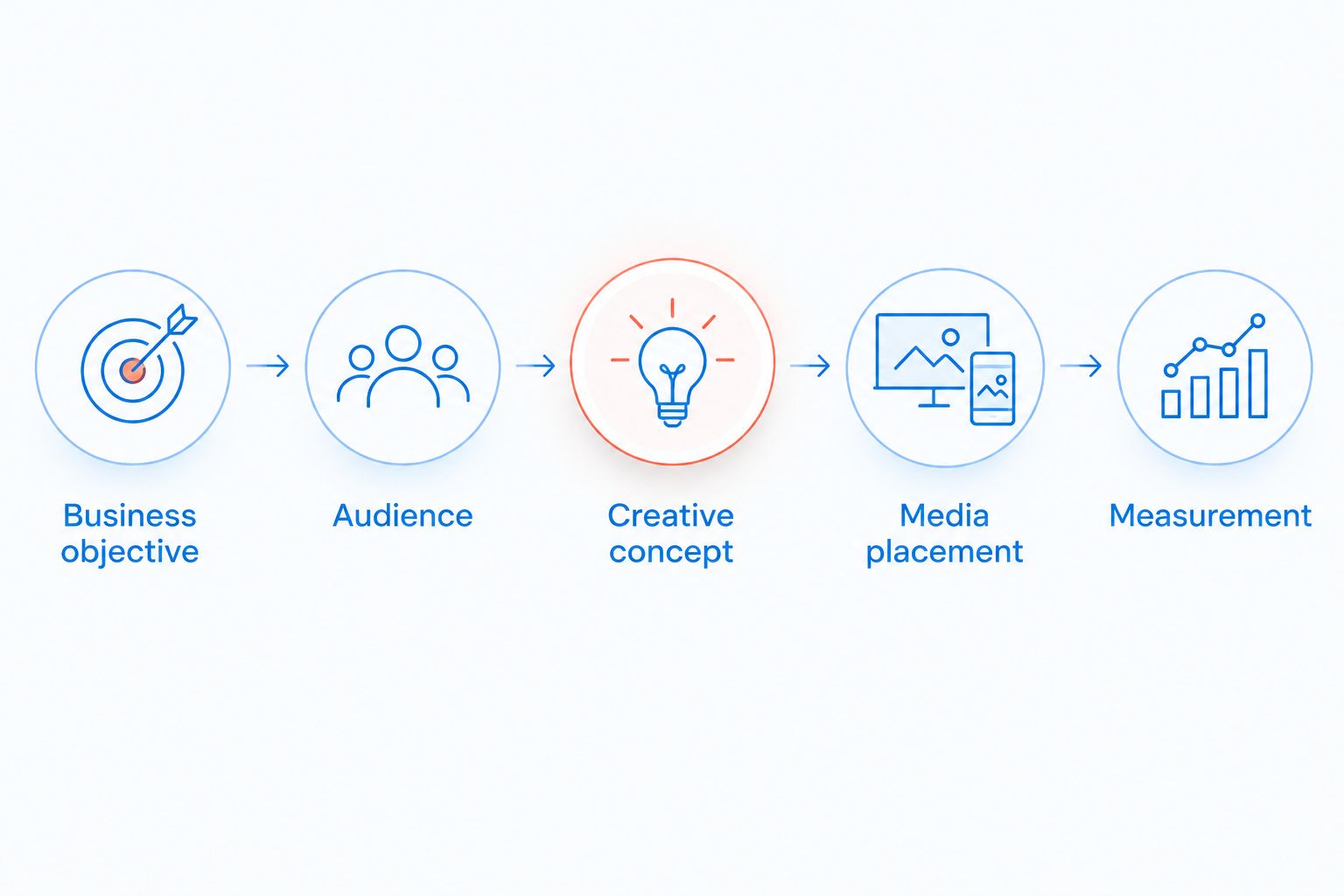
Decide how the campaign will work before deciding what to film.
Start with an internal working session, not a production proposal. Bring marketing, the relevant product owner, and whoever can confirm business results. Write down the action you want eligible consumers or existing members to take.
For membership acquisition, distinguish an inquiry from an application and an application from a completed membership. For product adoption, name the product and the qualifying action. Do not combine every business priority into one commercial simply because several departments want visibility.
Your 2027 brief should explain what success means before it describes the tone or visual treatment. Give the campaign one primary objective, then record secondary outcomes separately. This keeps a widely viewed awareness video from being judged against an application target it was never designed to support.
Close the brief with these decisions:
Use information your team already controls: member research, service questions, application feedback, and branch conversations. Look for a decision barrier, not just an age bracket. The reason someone hesitates should influence the message.
A prospective member needs to understand whether the credit union is relevant and whether they qualify. An existing member considering another product needs a different explanation. Treating those audiences as interchangeable produces broad language that answers neither audience well.
Write the barrier in plain English. Examples of questions to investigate include eligibility, the application process, and the difference between the advertised benefit and the member's current situation. These are research prompts, not assumptions about your membership.
Then narrow the creative assignment:
Draft the campaign idea internally before commissioning the finished execution. A useful concept states the audience's problem, the credit union's relevant benefit, the evidence supporting that benefit, and the next action. It does not need a finished script to be evaluated.
Bring a production and advertising partner into the process once that foundation is clear. J2 Marketing works with credit unions that want video production, campaign creative, and advertising services together. The trade-off is coordination: a combined engagement still needs a credit union decision-maker who can settle product, brand, and compliance questions.
Plan the asset family before the shoot. If your 2027 media plan needs both a 30-second commercial and a 15-second cutdown, each version needs a workable message and disclosure treatment. A shorter edit is not automatically a complete advertisement.
Make these production decisions together:
Create an approval sheet using current product documents and your credit union's review process. List every spoken claim, on-screen claim, testimonial, disclosure, and proposed call to action. Route that sheet to the people authorized to approve it.
Do this before scheduling the shoot. A claim that fails review after filming can affect dialogue, graphics, voice-over, and the final edit. Compliance review belongs in the creative process, not at the end of it.
Member stories need the same discipline. Confirm permission to use the person's identity and contribution, and avoid presenting an individual experience as a promise of what every member will receive. If you use performers, do not imply that they are actual members describing their own experiences.
Finish pre-production with a documented approval trail:
Use a shot list and delivery checklist your team can review without specialist equipment. Map each scene to a message requirement. If a shot does not support the benefit, proof, or next action, question whether it belongs in the production plan.
Production partners can translate that checklist into camera coverage, sound, editing, and graphics requirements. The advantage is execution depth; the limitation is that a production team cannot resolve an unclear business objective for you. Keep the approved brief available throughout the shoot.
Plan reuse deliberately. Your 2027 campaign needs clear records of where footage can appear, what permissions cover, and which product details will require updates. Separate reusable brand material from time-sensitive claims so an offer change does not make every asset unusable.
Request deliverables that match the plan:
Start with a measurement sheet that connects placement, creative version, destination, and business outcome. Your team can build it in a spreadsheet using existing advertising and membership reports. The important requirement is consistent definitions, not a new dashboard.
Report attention measures separately from business actions. Video views describe exposure or viewing behavior under the platform's definition; they do not establish completed memberships. Keep that distinction visible when presenting results to leadership.
For the 2027 annual plan, use the evidence to identify a specific next decision. If the message attracts interest but applications remain incomplete, investigate the application journey. If different openings produce different responses, use that information in the next creative brief rather than changing everything at once.
Keep the review focused:
Choose an operating model based on the work your internal team can own. A capable internal team does not need to outsource every task; a production studio does not automatically include campaign planning or ad placement. Confirm responsibilities in the scope.
For 2027 planning, compare the options against the same approved brief. Otherwise, you are comparing different deliverables rather than different ways to solve the same problem.
Internal marketing team
Independent production studio
J2 Marketing
Choose the model that closes your actual capability gap. If the missing piece is filming, buy production. If creative and placement are disconnected, define a combined campaign scope rather than ordering a standalone video.
A commercial that explains how the organization sees itself can leave the viewer without a reason to respond. Translate the campaign objective into a relevant benefit, then support it with approved evidence. Keep institutional history for situations where it helps establish that benefit.
An acquisition campaign should not attract people with no clear route to membership. Check audience selection, message, and destination together. Make eligibility understandable at the appropriate point without forcing the entire qualification process into the commercial.
Membership, lending, community engagement, and employer branding do not share the same decision journey. Give the campaign a primary job. Separate versions only when each has a distinct audience, message, and distribution purpose.
A finished commercial can still fail its intended use if framing, disclosures, or delivery specifications were not planned. Confirm these requirements before filming. Treat an approved script and placement specification as production inputs, not launch paperwork.
Views are not completed memberships. Present attention measures as attention measures, then show verified business actions separately. Where attribution is incomplete, report the boundary instead of assigning every new membership to the campaign.
What's the best way to plan commercial video production for credit unions?
Start with a defined membership or product-adoption objective, then connect the audience, creative concept, media placement, and measurement. Approve financial claims and production requirements before filming.
Should a credit union make a brand video or a product commercial?
Choose the format that matches the business objective. A brand video explains why the credit union matters to its audience; a product commercial supports a specific product decision and next action.
Is an agency better than a video production studio for a credit union?
An agency fits a credit union that needs campaign planning, creative, and advertising services together; a production studio fits a team that already owns strategy and placement. Compare the proposed scope, not the provider label.
How long should a credit union commercial be?
The commercial should match its placement specification and approved message. Plan 15-second or 30-second versions only when the media plan calls for them, and review each version's claims and disclosures separately.
Can a credit union use real members in advertising videos?
A credit union can use real members when it has appropriate permissions and an approved account of their experience. Confirm intended uses and avoid implying that one member's experience guarantees the same outcome for everyone.
How should a credit union measure a video advertising campaign?
Measure the business action named in the brief and report viewing metrics separately. Distinguish inquiries, applications, and completed memberships so attention does not get mislabeled as acquisition.
What should a credit union include in a production request?
Include the objective, audience, approved benefit, planned placements, deliverable formats, review responsibilities, and measurement requirements. Also specify permissions, ownership, and any restrictions on future use.
Before approving the production scope, ask each partner to show where the call to action, disclosure, and member benefit will appear in every planned version. Review the shortest version first: it forces the team to decide what the campaign actually needs to say.
Approve the campaign's job before approving its look. That decision keeps creative, production, and ad placement working toward the same result.